
Georgetown Berkley School of Nursing 2026 Commencement Speaker: Mary Wakefield, PhD, RN, FAAN
(April 27, 2026) — Mary Wakefield, PhD, RN, FAAN, got her start in health care as a teenager, working the evening shift at a nursing home and the night shift in the newborn nursery of a community hospital in Devils Lake, North Dakota, a rural town more than 100 miles from the nearest large hospital.
She would eventually go on to hold one of the highest positions in federal health care as acting deputy secretary in the U.S. Department of Health and Human Services (HHS). But her early journey, she said, was guided by a simple lens: “How can I help people, and where might I find meaningful, interesting work?”
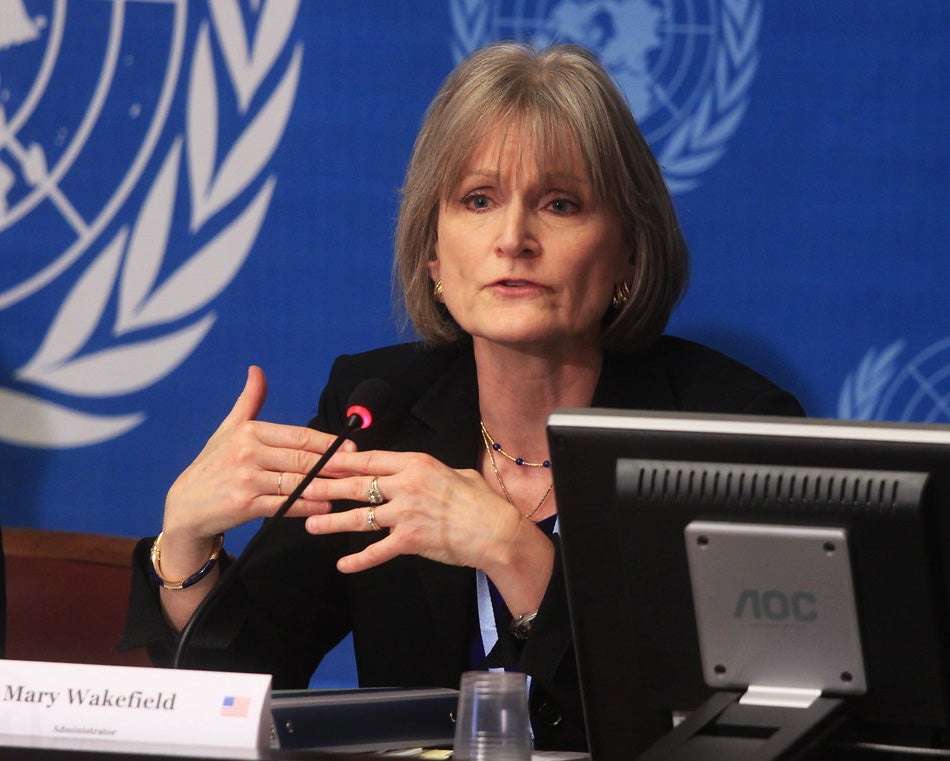
Mary Wakefield, PhD, RN, FAAN, at the United Nations
The nurses she observed at that small community hospital, without the specialists or resources of larger institutions, gave her the first answer. She recalls being “dazzled” watching them improvise and problem-solve in real time.
“They made a singular difference, minute by minute, shift by shift, in people’s lives and in the lives of their families,” she said. “That force was palpable. I saw it, I felt it, and I wanted to be one of them.”
She attended the University of Mary in Bismarck, North Dakota, a small Catholic college run by Benedictine nuns. Their philosophy of welcoming everyone and treating them as family regardless of where they’re from informed her approach to nursing from the start.
After graduation, she went to work in an intensive care unit. Exhilarating as it was, she came to see it as a kind of “Band-Aid station,” as the strokes, heart attacks and jobsite accidents were, in many cases, preventable. She realized the issues shaping health and disease were much broader than what she was seeing at the bedside.
“People were coming through as a result of what had happened — or hadn’t happened — upstream,” she said. “The deaths, financial stress, personal and physical toll: Much of it was preventable with better access to health insurance, affordable care, or geographic access to services.
Headed to Capitol Hill
That recognition drove her back to school for a master’s degree and eventually a PhD at the University of Texas at Austin, where a required health policy course revealed the role nurses can and should play in shaping it.
After graduation, she joined the faculty at the University of North Dakota, teaching nursing students that health policy was as much a part of the profession as clinical practice.
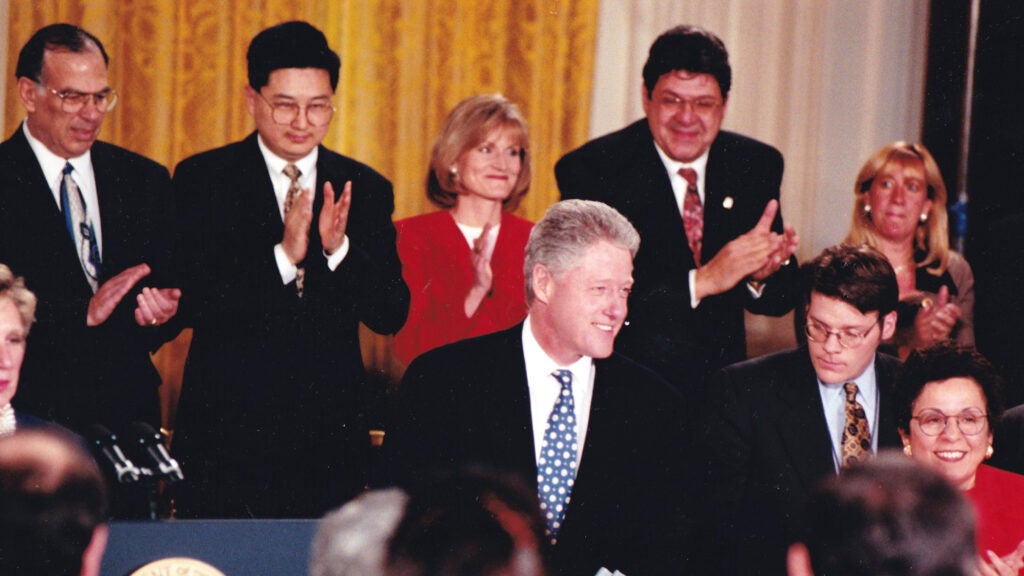
Wakefield (back row center) moved into the public policy world during the Clinton administration.
Eager to gain firsthand experience shaping federal policy, she made a cold call to her congressional delegation that landed her a job offer from Sen. Quentin Burdick of North Dakota.
“There I was, well-established on an academic trajectory, still moonlighting clinically on weekends, and suddenly faced with a real choice: continue on the path I was on, or shift and take this opportunity,” Wakefield said.
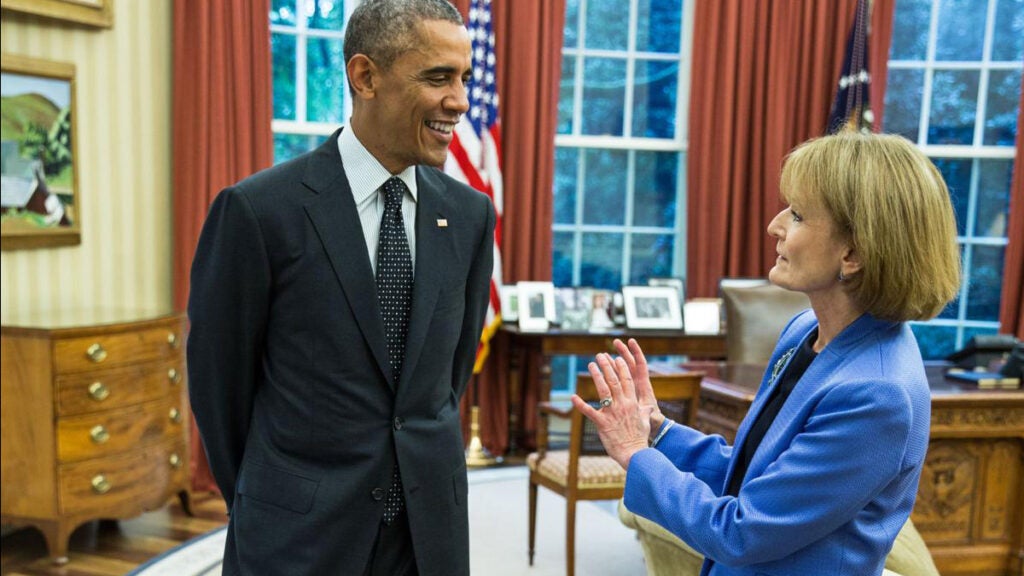
Wakefield with President Barack Obama
She took the leap, and over the next eight years rose to chief of staff, first for Sen. Burdick and then for Sen. Kent Conrad, also of North Dakota. She was regularly asked what a nurse was doing on Capitol Hill.
“My answer was always the same, and to me it was so fundamentally obvious: ‘It’s because I’m a nurse that I’m here,’” she said.
At the Highest Levels
Six years later, she was appointed by President Obama to the position of deputy secretary of HHS. There she oversaw a $10 billion federal agency charged with expanding access to care for underserved communities, overseeing more than 80 health programs.
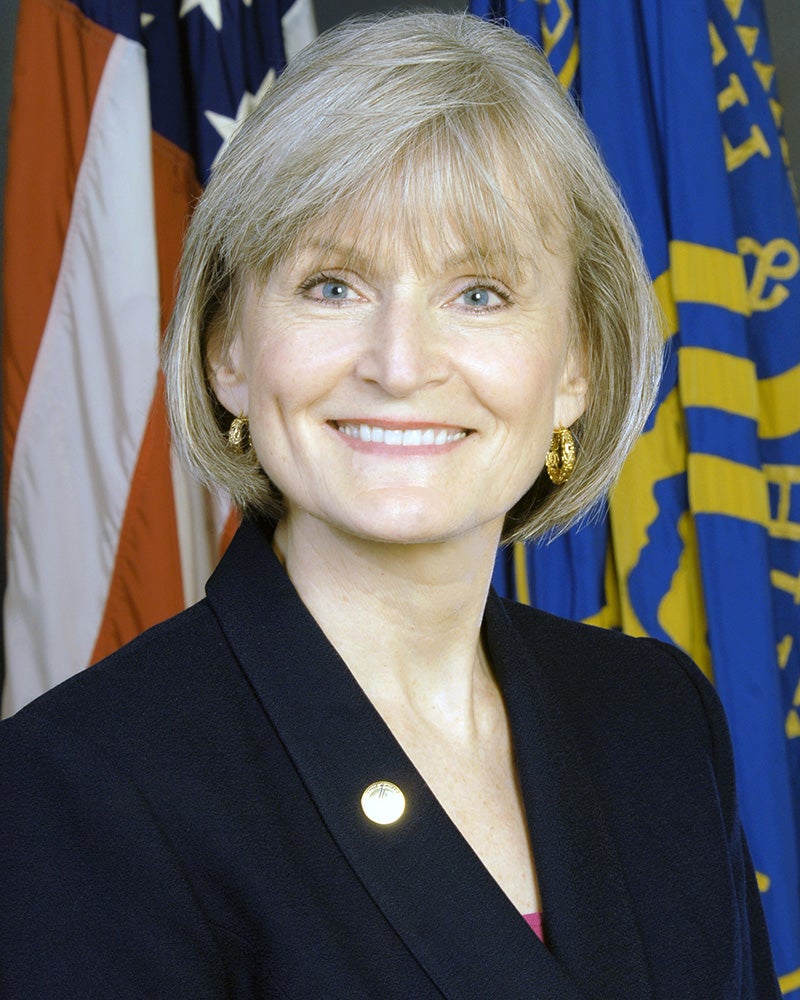
Wakefield was appointed to lead HRSA in 2009.
Six years later, she was appointed by President Obama to the position of acting deputy secretary of HHS, the second-highest position in the largest cabinet agency, overseeing a $1 trillion budget and 80,000 employees. Once again, she was the first nurse to hold that position.
“I wanted to do the work so exquisitely well that there would be no question that a nurse was exactly the right person for that job — that the credential itself would be seen as an asset, not a question mark,” she said.
Wakefield never lost her zeal for direct patient care. From her row house in the Capitol Hill neighborhood, her window looked directly into the patient rooms of the hospital across the street, where she would watch nurses moving through those rooms late at night.
While she missed the clinical setting, she made sure to go out into the field as often as she could, visiting community health centers and rural hospitals, asking what the federal government was doing right and what obstacles it was throwing up.
“A patient in pain, a constituent who is dissatisfied — you’re always looking for those cues,” she said. “You’re always scanning the gray space, the engagement between disciplines where you develop a collective view of a problem and where the best solutions tend to emerge.”

As Acting Deputy Secretary of Health and Human Services, Wakefield visited Vietnam Medical University in Hanoi in 2016.
Five Patients or Five Million People
A member of the National Academy of Medicine (formerly the Institute of Medicine or IOM), Wakefield served on the IOM’s committees that produced two of the most consequential health care reports of the past decades: “To Err is Human” and “Crossing the Quality Chasm.”
She also co-chaired the National Academy of Medicine committee that produced the “Future of Nursing 2020–2030” report, which laid out a blueprint for achieving health equity through the nursing profession. In 2019, the American Academy of Nursing named her a Living Legend, its highest honor.
“Nurses are known for what we do, but we’re not always recognized for what we know,” she said. Changing that is among the most urgent work ahead for the profession and for the students entering it today, she added.
Wakefield serves on a number of nonprofit boards, including the Josiah Macy Jr. Foundation, which works to advance health professions education, and remains an active voice for nursing’s role in public policy. She returns to Georgetown’s Berkley School of Nursing as a familiar presence, having previously served as a visiting professor.
“You can make a difference for five patients or for five million people,” she says, “and both are important.”
All images courtesy of Mary Wakefield or public domain
- Tagged
- Commencement 2026